

Hailley’s Scroll: Building an AI social media coach with my social data
I turned a year of my own posts into context for AI — here's the system, and the exact prompts.

We’ve got a takeover this week! Every so often, I hand the keys to The Weekly Scroll over to someone I think we could all learn from. Last time, it was Phill; this time, it’s Hailley, who leads communications and content here at Buffer and is one of the most systems-brained people I know. She builds systems for basically everything, and then writes about them. So I asked her to share one she’s been deep in lately. I’ll let her take it from here.
Hi folks! It’s been a minute since I’ve been in our newsletter, and it’s wonderful to be back.
We’re going to → grab all of the context about your recent posts → analyze it to look for patterns and gaps → set up a workflow so that you are checking your social posts against your social goals and staying on track.
I’ve been tracking my LinkedIn metrics for a while, and I have specific goals, but I’d never connected the context I could gather from my own posts to having AI coach me toward the output I actually want.
So here’s the system I built and the exact prompts I used, so you can do the same (if you’d like).

1. Pull all of your recent social posts
This is easier than you might think, and very important. Successful systems work because they are tailored to you, so we need the context.
I grabbed all my posts by connecting my Buffer account to my Claude account and asking Claude to grab them for me. (Possible on all Buffer plans, even free.)
→ Here’s a full guide to Buffer’s AI integrations and how to connect them.
If you’re in Buffer’s beta, you can also export all of this from the new Insights tab.
Here’s what I asked Claude (you can use any AI tool; Claude is just my preference):
Via Buffer, pull all of my posts on [social network] from the last [time period] — the caption, the date posted, and all of the associated analytics.
2. Build the analysis most useful to you
This is where it gets fun — and where you get to be specific. The focus here isn’t one perfect prompt; it’s deciding what you most want to understand about your own posting, then asking for exactly that. A few options for you:
Content pillars: what you post about most, and how the mix breaks down
Your voice: your real writing style, sentence patterns, the words and phrases you lean on
What is performing: your most- and least-engaged posts, and what they have in common
Formats: whether text, photo, video, or link posts perform differently for you
Hooks: which opening lines you use most often, which are getting engagement, and which aren’t
Timing: the days and times you post most and whether that aligns with the best time to post data
Conversion: whether the posts meant to drive something (subscribers, sales, calls) are getting traction
Pick the few that matter most to you and drop them into the prompt:
Pull all my [social network] posts from [time frame] with their text, dates, and metrics (reactions, comments, impressions, reach). Build me an artifact analyzing [the 3–4 things you picked above]. Don’t generalize from social media best practices — only use my data.
Two things mine surfaced that I wouldn’t have guessed: my pillars were lopsided (I post about systems and marketing constantly, and about career far less — even though that’s something I’ve highlighted as a content pillar for myself), and my most personal posts do the most work (a quick one about taking my birthday off work pulled 104 reactions and 30 comments).
With all of this context, it’s time to reflect.
A simple Keep, Start, Stop is always effective. Based on what you found, what do you want to Keep doing, what do you want to Start doing, and what do you want to Stop doing.
A few more pointed questions you could reflect on:
Is there a gap between what I want to post about and what I am posting about?
Have I selected the right days and times to send my posts out to reach my audience?
Are the formats I’m using performing well, or do I need to experiment?
3. Use this analysis + AI to have a social coach in your pocket
The analysis is a goldmine of context, and now we use it. If you have specific goals as a creator or as someone managing social profiles, you can use this analysis and your goals to get some really valuable coaching and advice on what to adjust in your strategy or what to post next.
Here’s what I said to Claude:
Here are my goals for [social network] this year: [your goals]. Use the analysis of what I’ve actually been posting that you’ve already conducted. Act as my content coach. Based on the analysis, what do I need to do differently to reach my goals?
To make the coaching sharper, I also handed Claude a few Buffer resources as context, so we know its advice comes from real guidance and not just vibes:
Your Complete Guide to Social Media Marketing: Platforms, Strategy, and Tips for Growth
The Best Time to Post on Social Media in 2026: Times for Every Major Platform
Algorithm information for: LinkedIn, TikTok, Instagram, Facebook, X, YouTube Shorts, and Threads.
From there, you can access this coach as often as you’d like: I’d recommend at least monthly.
I set up a monthly Claude Cowork scheduled task to run this analysis fresh and compare it to my goals again to coach me on adjusting my content for the following month.
You could also set a reminder in your to-do list to check in as frequently as you need.
Fit this into your own existing workflows to have the highest chance of success here.
If you take one thing from this issue, let it be this: you already have the best dataset for getting better on social media through your own content. Next up, it’s about using it.
If this is your kind of thing, I write a newsletter about building systems for work and life that keep me productive, calm, and organized, usually based on what I’m figuring out in real time. → You can subscribe here
WHAT’S IN THE SCROLL?
Hi, Tami here, popping back in to share what’s in my scroll this week! I spotted a post in my LinkedIn morning scroll from Austin Null recently — and it stopped me in my tracks because it had two names at the top instead of one.
That’s when I found out: soon, two or more people, plus LinkedIn Pages (!), can share one post together, with every collaborator listed at the top. It’s in beta with creators and brands now (I guess I missed my invite in the mail) and will roll out over the coming months.
As someone who has been using collab posts on Instagram forever and will get a lot of use out of this feature on LinkedIn, I figured I’d write up everything we know so far: so here’s everything we know about LinkedIn collab posts.
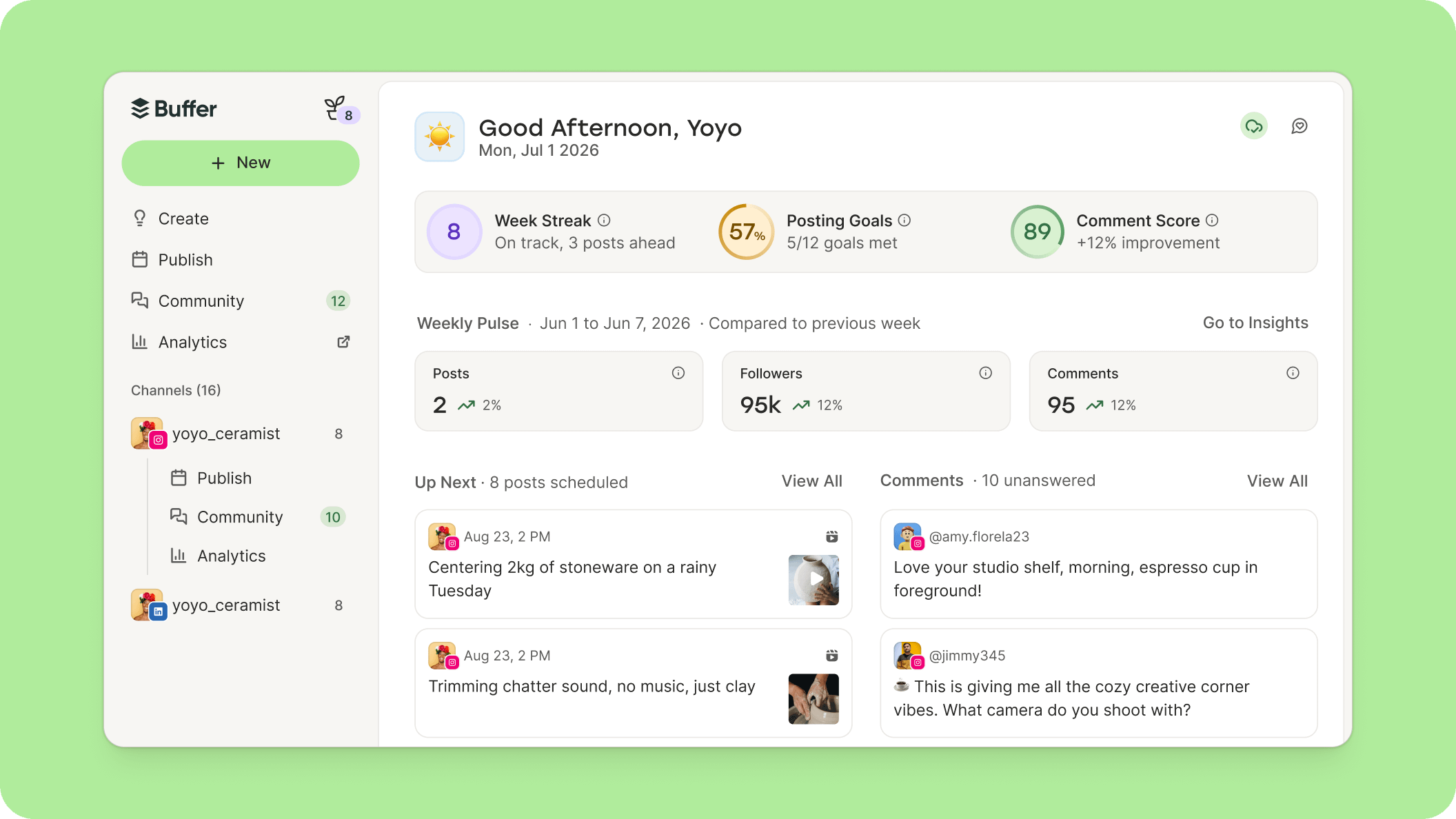
Something else I’ve been keeping a close eye on is our new Buffer Home. It’s a new landing page and hub for all your social activity and brings in elements of each area of Buffer (streaks, upcoming posts, more!) into a single view. Give it a try and let us know what you think.
And if you’d like to guest-write an issue of The Weekly Scroll, reply to this one with your idea, and I’ll reach out!
If you found your way here through Hailley — welcome. This is The Weekly Scroll, Buffer’s newsletter for creators and social media pros. We’d love to have you.
Alright, that’s it — see you next Friday!
Tami
Sr. Content Creator
Thanks again for having me, Tami! This was a lot of fun to write or share.
If you're reading, leave me a comment with any thoughts. I'd love to keep building on this system. 😎